
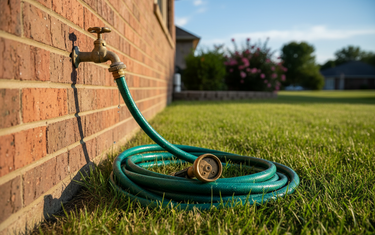
How to Choose a Freezeless Wall Hydrant (And Why the Length Actually Matters)
If you've ever dealt with a burst outdoor faucet in February, you already understand why freezeless wall hydrants exist. If you haven't — and you're still running a standard sillcock on the exterior of a cold-climate home — this article is worth your time before next winter arrives.
Here's what you need to know to choose the right hydrant, measure correctly, and avoid the most common installation mistake that causes even a good hydrant to fail.
What Is a Freezeless Wall Hydrant?
A standard outdoor faucet (sometimes called a sillcock or hose bibb) has its shutoff point right at the wall. When you close it, water sits in the valve body and the exposed spout. In freezing temperatures, that trapped water expands, and you end up with a cracked valve body or a burst pipe inside the wall.
A freezeless wall hydrant solves this by moving the shutoff point inside the building. The valve stem extends through the wall into the heated space, and the seat — where the water actually stops — sits several inches inside, past the frost line. When you turn the handle off, the water drains out of the stem and spout completely. There's nothing left in the exposed portion to freeze.
The key word is "drains." The stem has a slight built-in pitch so gravity pulls the water back out every time you shut off. That drainage is what protects the hydrant — not insulation, not pipe heat tape, and not hoping for a mild winter.
For a visual breakdown of how the shutoff mechanism works, Prier's installation and maintenance guide for the C-144 walks through the drainage sequence in detail and covers the difference between normal post-shutoff dripping and a failing seat washer.
Why the Length Matters More Than You Think
This is where most homeowners and even some contractors get tripped up. A freezeless hydrant only works if the valve seat — the shutoff point — sits inside the heated envelope of the building. If the seat ends up inside a thick wall, inside a cavity full of insulation, or anywhere that drops below freezing, you've defeated the whole purpose.
The length you need is simply the distance from where your interior supply pipe connects to the hydrant, to the outside face of the wall. That measurement varies a lot depending on construction type.
Here's a practical guide:
| Wall type | Recommended reach |
|---|---|
| Standard wood frame with sheathing | 4" — Prier C-144D04 |
| Thicker frame wall or added rigid foam insulation | 6" — Prier C-144D06 |
| Double-wall or heavily insulated sheathing | 8" — Prier C-144D08 |
| Masonry veneer over wood frame | 10" — Prier C-144D10 |
| Standard brick or concrete block | 12" — Prier C-144D12 |
| Thick masonry or insulated concrete form (ICF) | 14" — Prier C-144D14 |
Measure before you order. Don't guess. A hydrant that's an inch too short puts the seat inside your wall insulation — right where temperatures can still drop below freezing in a hard winter.
If you're unsure about your local frost depth — the depth at which ground and wall temperatures consistently stay above freezing — the NOAA frost depth maps provide county-level data across the continental US. As a rule of thumb, in climate zones 5 and above (most of New England, the upper Midwest, and the mountain states), wall insulation values are high enough that the 6" or 8" reach is frequently the right call even on standard wood-frame construction.
The Backflow Protection Requirement Most Homeowners Don't Know About
Here's something that often comes as a surprise: most plumbing codes require an anti-siphon device on any outdoor hose connection. The reason is back-siphonage — a drop in supply pressure can pull water backward from a hose that's submerged in a bucket, a chemical sprayer, or a pond. Without backflow protection, that contaminated water can be pulled back into your drinking water supply.
This isn't a theoretical risk. The EPA's Cross-Connection Control Manual identifies garden hose connections as one of the most common sources of residential cross-contamination, precisely because hoses are routinely submerged in buckets, pools, and irrigation systems.
The Prier C-144 Diamond Series addresses this with two layers of protection built into the same valve: an atmospheric anti-siphon vacuum breaker and a separate EPDM backflow check valve rated to 125 PSI. Together they meet ASSE 1019 — the American Society of Sanitary Engineering standard that most state and local plumbing codes reference for outdoor hose connections. If you're replacing an older sillcock or a basic hose bibb, adding an ASSE 1019-listed hydrant is typically required to bring the installation up to current code.
You can verify whether your state has adopted ASSE 1019 as a code requirement through the International Association of Plumbing and Mechanical Officials (IAPMO), which publishes the Uniform Plumbing Code adopted by most western states, or through the International Code Council (ICC) for the International Plumbing Code used across much of the rest of the country.
If you're in a situation where you need lead-free certification — a rental property, a commercial building, or a jurisdiction with strict lead-free requirements — the Prier 478-12-LF is the Mansfield-style lead-free option in a 12" reach, carrying ASSE, IAPMO, and CSA certifications. Lead-free requirements for plumbing fixtures in contact with drinking water are governed federally by Section 1417 of the Safe Drinking Water Act, which limits lead content to a weighted average of 0.25% in wetted surfaces — worth confirming for any commercial or rental property installation.
When You Need Hot and Cold at the Exterior
Standard wall hydrants are cold-water only. If you need tempered water on the outside of the building — for washing a vehicle without freezing your hands, for a utility area, for pet washing stations, or for any application where scalding risk is a concern — you need a mixing hydrant.
The Prier C-108 Diamond Series connects to both hot and cold supply lines and allows you to dial in a mixed temperature at the spout. It's available in a 6" reach for frame wall installations and a 12" reach for masonry. At $138–$153, it's a higher investment than a standard hydrant, but it's the right call for any exterior application where water temperature matters.
For installations involving children — a backyard play area, a school, a daycare facility — the ASSE 1070 standard for water temperature limiting devices may apply, depending on your jurisdiction. The C-108 allows manual temperature adjustment but does not include an integral high-limit stop; consult your local plumbing code or a licensed plumber if a thermostatic mixing valve is required at the point of use.
The One Mistake That Destroys Even a Good Hydrant
Leave a garden hose connected when temperatures drop below freezing.
It sounds obvious, but it's the most common cause of hydrant failure — even on brand-new quality units. Here's why: the vacuum breaker in the hydrant cap opens to atmosphere when the handle closes, allowing air in so the stem can drain. A connected hose creates back pressure that holds the vacuum breaker shut. The stem can't drain. Water sits in the hydrant through the freeze. The stem ruptures.
Prier addresses this directly in their C-144 installation and operation guide: always remove hoses during freezing temperatures. Not "probably" remove them. Not "if it gets really cold." Every time.
If you need a hose connection that can stay attached — for an irrigation system, for a commercial application, or anywhere the hose can't easily be disconnected — talk to us about a different valve configuration. A standard anti-siphon hydrant with a permanently connected hose is not the right setup for that application. Vacuum breaker-equipped hydrants by design require atmospheric exposure at shutoff to drain correctly; a permanently attached backflow preventer downstream of the hydrant is the appropriate solution in that scenario, installed by a licensed plumber per local code.
What to Expect After Shutoff
A freezeless wall hydrant will drip from the spout for 30 to 60 seconds after you turn it off. That's normal — it's the stem draining. Prier's own documentation notes this explicitly: if dripping continues beyond 60 seconds, the seat washer likely needs replacing. On the C-144, that's a standard OO beveled bibb washer, available at any plumbing wholesaler or as Prier kit C-134KT-802.
If water is leaking from behind the handle while the hydrant is running, the packing needs tightening or replacement. Tighten the packing nut with a crescent wrench first — that usually stops it. If it keeps coming back, the packing kit is C-134KT-803. Prier has produced a repair video series for the C-144 covering packing replacement, seat washer replacement, and vacuum breaker service — worth bookmarking before you need it.
The full C-144 overhaul kit (C-144KT-807) covers everything that wears: seat washer, packing, vacuum breaker, and backflow check valve. It's a good thing to have on hand if you're installing a new hydrant or taking ownership of a house with an existing one.
Angle Sill Faucets: A Different Application
If you need an outdoor water connection where a through-wall installation isn't practical — a crawl space access point, a garage utility area, a basement wall application — an angle sill faucet is worth considering. The Prier C-135CP.50 is a heavy-pattern brass angle sill faucet designed for exactly this. It's not a freezeless design, so it needs to be installed in a space that stays above freezing, or used with a separate shutoff and drain. But for the right application it's a simpler, lower-profile solution than a full wall hydrant.
Choosing the Right Hydrant: A Quick Summary
- Measure your wall before ordering. Length = interior supply connection to outside face of wall.
- Match your wall type to the right reach — a 4" hydrant in a 10" masonry wall is not freeze-protected.
- Confirm ASSE 1019 compliance — required by most codes for outdoor hose connections.
- Remove hoses in freezing weather — every time, without exception.
- Budget for the C-108 if you need mixed temperature at the exterior.
- Keep a rebuild kit on hand — the C-144 is fully field-serviceable with standard parts.
Have questions about which reach fits your wall, or need a size beyond 14"? Call us at 844-620-9482 or email customerservice@plumbingplanet.com. We're open Monday through Friday, 8am–5pm EST, and we're happy to help you measure before you order.