
The first cold night of the season has a way of exposing every problem your heating system has been quietly developing since spring. A sticking aquastat, a circulator pump on its last bearing, an expansion tank that lost its air charge — none of it announces itself until you actually need the heat. By then, you're troubleshooting in the cold instead of preventing the failure in the first place.
Fall is the window to catch these issues while it's still 60 degrees outside and a failed part is an inconvenience, not an emergency. Here's a room-by-room, part-by-part checklist for getting furnaces, boilers, and hydronic systems ready for winter.
Why Fall Is the Right Time to Do This
Heating systems fail most often in their first heavy-use week of the season — not because they broke overnight, but because components that were marginal all summer finally get put under real load. A pump that's been quietly losing efficiency, a control that's been cycling erratically, a tank that's been slowly waterlogged — fall is when these show their hand.
Doing a maintenance pass now means:
- You're troubleshooting with time and daylight, not during a no-heat emergency call
- Replacement parts are in stock and shipping normally, before the seasonal rush
- You catch a $150 part before it takes out a $2,000 pump or heat exchanger
Furnace Checklist
Inspect and replace air filters. A clogged filter is still the single most common cause of furnace short-cycling and overheating. If it's been more than 90 days, replace it.
Test the fan and limit controller. This is the safety switch that turns the blower on and off at the right temperatures and shuts the furnace down if it overheats. A failing fan/limit controller (like a Resideo L4064B2210/U or L4064B2228/U) shows up as a furnace that runs too hot, short-cycles, or won't kick the blower on at all.
Check burner operation and ignition. Listen for delayed ignition, rough starts, or a burner that won't stay lit — early signs of a failing burner control.
Clear the flue and combustion air paths. Confirm nothing — leaves, nests, debris — is blocking intake or exhaust before the system runs daily.
Boiler & Hydronic System Checklist
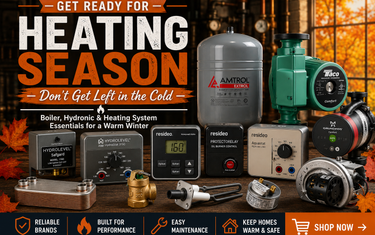
Check the expansion tank. If your system is losing pressure, has a waterlogged tank, or you're hearing banging pipes (water hammer), the expansion tank has likely lost its air charge or failed. This is one of the most overlooked causes of pressure problems going into winter — worth checking before you troubleshoot anything else. Products like the Amtrol EXTROL 102-1 EX-30 or the 118-27 SX Series vertical tank are common direct replacements.
Test the low water cut-off (LWCO). This safety device shuts the boiler down if water level drops too low — critical for preventing dry-fire damage. LWCOs like the Hydrolevel Safgard 1150 or Safgard 45-550 should be tested at the start of the season, not discovered faulty mid-January.
Inspect the circulator pump. Grinding noise, leaking around the seal, or uneven heat across zones usually traces back to the circulator. If yours is aging, look at direct-fit options like the Taco 007, Bell & Gossett Red Fox NRF, or Grundfos Comfort 10-16.
Check aquastat and relay settings. The aquastat controls water temperature and, on many systems, cycles the circulator. A miscalibrated or failing aquastat (Resideo's L6006C, L4008A, and L8148E series are common culprits) causes inconsistent heat or a boiler that won't reach temperature.
Oil Heat Systems: Additional Checks
If you're running an oil-fired system, add these before the season starts:
- Test the burner control (Resideo Protectorelay R8184 series) — this governs ignition sequencing and safety shutoff
- Check the aquastat for accurate temperature control and consistent cycling
- Replace oil nozzles and filters — degraded nozzles cause poor combustion, soot buildup, and higher fuel use
When to Call a Pro vs. DIY
Filter changes, visual inspections, and checking for leaks or unusual noise are reasonable for a handy homeowner. Anything involving gas lines, combustion settings, electrical controls, or refrigerant should go to a licensed technician — and for contractors, this checklist doubles as a standard fall service call script.
The Bottom Line
Most heating system failures aren't sudden — they're the end result of a part that's been degrading for months, finally pushed past its limit by the season's first real cold. A 30-minute check now, and a $100–300 part if something needs replacing, is a lot cheaper than an emergency no-heat call in January.
Browse the full Fall Heating System Essentials collection for the expansion tanks, circulators, LWCOs, and controls covered in this checklist — all in stock ahead of the season.